
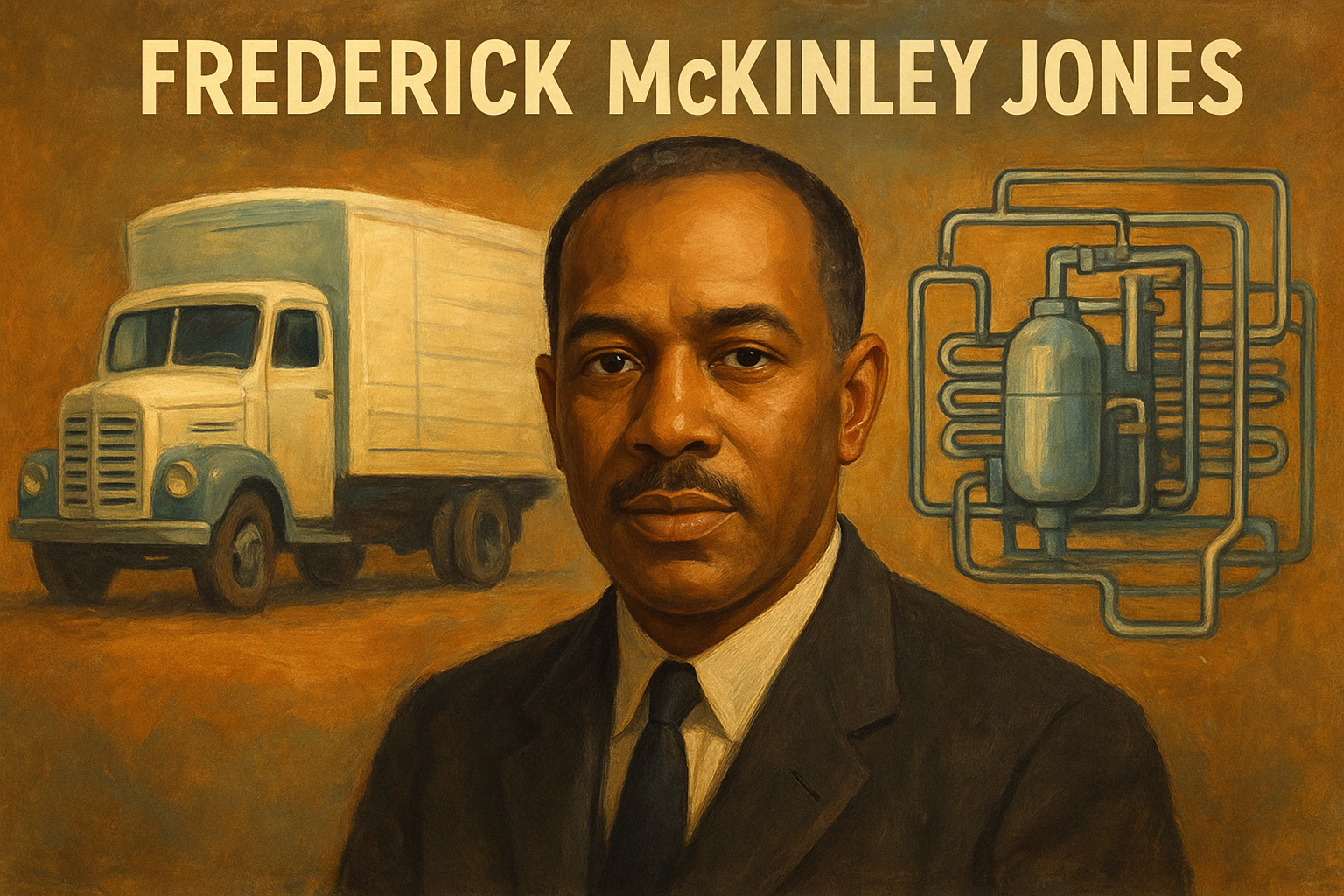
Frederick McKinley Jones: The Inventor Who Transformed Modern Logistics
When people talk about the greatest inventors in American history, the conversation often centers on names that appear in school textbooks. Yet one innovator quietly reshaped industries that touch nearly every moment of daily life. His name is Frederick McKinley Jones. His work made it possible for fresh food, medicine, blood plasma, and temperature sensitive goods to move safely across long distances. His inventions shaped global supply chains, supported troops in wartime, and helped build the modern refrigerated transport system that the world depends on today.
Learning about his journey is more than revisiting historical facts. It gives us insight into what determination, curiosity, and skill can achieve even in the face of social and economic barriers. I have studied technology for years, and few inventors stand out to me the way Jones does. His work blends engineering skill with a deep understanding of practical, real world problems. That combination is rare, and it explains why his impact continues to grow decades after his passing.
This article explores his life, inventions, influence, and what modern creators can learn from him. You will find a clear and detailed explanation of his contributions, along with insights that relate to present day technology and logistics.
Early Life and the Path to Engineering
Frederick McKinley Jones was born in 1893 in Cincinnati, Ohio. His childhood was difficult, and he faced limited opportunities. He left school early and grew up working various jobs with little formal direction. Yet he showed an interest in machines from a young age. He spent hours taking apart mechanical devices just to understand how they worked. This habit became the foundation of the engineering approach he used throughout his life.
Many great inventors follow unconventional paths, and Jones was no different. Without access to technology programs or engineering mentors, he learned by doing. He taught himself to repair engines, diagnose problems, and design simple mechanical solutions. From my experience working with self taught technicians, I know that this type of hands on learning leads to a strong problem solving mindset. It forces a person to be resourceful and detail oriented, and Jones mastered both qualities.
In his early twenties, he began working as a mechanic on farms and later as an automobile technician. His reputation grew because he could repair machines that others could not fix. People trusted him not only for his skill but also for his reliability. These traits prepared him for a future that no one, including Jones himself, could have predicted.
Military Service and Technical Growth
During World War I, Jones served as an Army technician in France. That experience changed his life. He learned about advanced mechanical systems, power generation, and electrical equipment. Exposure to these technologies expanded his abilities and deepened his confidence. Veterans often talk about how military service sharpens practical thinking, and Jones carried that discipline into his engineering career.
After the war, he returned to Minnesota and accepted a job as a mechanic at a local farm equipment company. His coworkers often asked him to help with electrical systems, refrigeration units, and engine problems. He could diagnose faulty machines simply by listening to their operation. This level of skill usually comes only from years of experience, and Jones gained it through constant practice.
The late 1920s and early 1930s were a time when America needed new ideas to solve emerging industrial challenges. Jones was ready to contribute.
The Invention That Changed the World
The most important achievement in Frederick McKinley Jones’s career arrived when he created the first successful mobile refrigeration system for trucks. This invention made it possible to transport perishable goods over long distances without spoilage. Before this breakthrough, food delivery was limited by geography, weather, and time. His design transformed that reality.
The idea began with a simple question: How can we make refrigeration portable, reliable, and safe for long trips on uneven roads?
Jones approached this challenge like a true engineer. He studied existing cooling systems, identified their weaknesses, and tested multiple prototypes. The machine he eventually developed was compact, durable, and efficient. It used a closed system that maintained stable temperatures regardless of outdoor conditions.
From my background in logistics consulting, I can say that this type of innovation often demands creativity, patience, and an understanding of real business needs. Jones had all three. His invention solved a direct problem faced by food suppliers, distributors, and medical teams. It was a practical solution with far reaching consequences.
In 1938, he partnered with businessman Joseph Numero to form a company that would later become a major force in the refrigeration industry. Their products quickly gained national attention because they solved a problem that no one else had solved well.
Impact During World War II
When World War II began, the United States military needed reliable refrigeration systems to ship blood plasma and medical supplies to soldiers worldwide. Jones adapted his mobile cooling technology for military use. His systems allowed life saving materials to reach troops in extreme climates, which made him an invaluable contributor to the war effort.
I have spoken with logistics professionals who study wartime supply chains, and many describe Jones’s contributions as one of the turning points in modern military transport. Without stable temperature control, thousands of units of blood and medicine would have spoiled before reaching soldiers. His work saved lives on the battlefield even though he never stepped foot there.
His wartime innovations earned him national recognition, and after the war, his company expanded further. The commercial food industry, pharmaceutical companies, and international traders benefited directly from his designs.
Key Inventions Beyond Refrigeration
While he is best known for mobile refrigeration, Frederick McKinley Jones had more than sixty patents. His inventions covered audio equipment, X ray devices, gasoline engines, and automatic motor controls. A few examples illustrate his range:
- Movie sound equipment
He developed a system that synchronized sound with motion pictures, which helped theaters project clearer and more stable audio. This contribution is often overlooked, yet it played a role in improving early film production and screening. - Portable air cooling systems
These systems provided cooling in locations that lacked electricity. They benefited rural communities and small businesses. - Automatic starting controls for engines
This technology improved the efficiency of machines used in agriculture and construction, reducing downtime and manual labor.
Jones approached all challenges with a direct mindset. He identified the simplest way to make a machine more effective, then built a durable solution. That mindset is something many engineers today still admire.
Challenges and Barriers He Overcame
Frederick McKinley Jones worked during a time when African American inventors rarely received recognition. He faced racial discrimination, limited access to funding, and few formal training opportunities. Despite that, he built a career based on skill, innovation, and integrity.
From a historical standpoint, his achievements highlight the importance of resilience. Many inventors with fewer obstacles never accomplished what he did. His story proves that talent can thrive even in difficult circumstances when paired with discipline and persistence.
Lessons Modern Innovators Can Learn from Jones
Professionals in engineering, logistics, product development, and entrepreneurship can learn several lasting lessons from Jones’s life. These insights come from both his story and my experience working with product teams that push for long term innovation.
- Good solutions begin with real problems
Jones focused on issues that affected daily life. His inventions were practical, not theoretical. - Hands on learning can be as powerful as formal education
His career shows that curiosity and self discipline can build expertise even without advanced degrees. - Innovation requires persistence
Jones refined his designs over years. He did not settle for early prototypes. He tested again and again until the results were dependable. - Versatility strengthens creativity
He worked across mechanics, refrigeration, audio engineering, and electrical systems. That range helped him solve complex problems with simple ideas. - Social barriers cannot limit true talent
His success demonstrates how excellence can break through even when systems work against a person.
Real World Applications Today
If you have ever received fresh groceries delivered to your home, bought refrigerated items at a supermarket, or relied on safely transported medicine, you have benefited from the work of Frederick McKinley Jones. The modern cold chain system exists because of his early breakthroughs.
In food supply:
Transport trucks use principles based on his mobile cooling systems to keep produce, meat, dairy, and other perishables fresh during long trips.
In healthcare:
Vaccines, insulin, laboratory samples, and temperature sensitive medications depend on stable cooling during transport. That reliability traces back to Jones’s inventions.
In global trade:
Cold storage containers are essential for international shipping. Their technology reflects the same core designs that Jones developed nearly a century ago.
Industries worldwide owe part of their stability to his ideas. Few inventors influence so many sectors for so long.
FAQs
Who was Frederick McKinley Jones?
He was an American inventor known primarily for creating the first practical mobile refrigeration system for trucks, which transformed food and medical supply transportation.
Why is he important in modern logistics?
His refrigeration technology made it possible to move perishable goods safely over long distances. This innovation shaped the cold chain system used worldwide.
How many patents did he hold?
He held more than sixty patents spanning refrigeration, audio equipment, engines, and control systems.
Did he have formal engineering education?
No. He was largely self taught and learned through experience, experimentation, and mechanical work.
What industries rely on his inventions today?
Food supply, healthcare, transportation, military logistics, and global trade all rely on systems that evolved from his early designs.
Conclusion
Frederick McKinley Jones remains one of the most influential inventors in modern history. His ideas shaped global trade, strengthened healthcare logistics, and improved daily life for millions of people. His journey shows that innovation grows out of curiosity, resilience, and a willingness to solve real problems. His legacy continues to inspire engineers, creators, and business leaders who want to build solutions that matter.